
61. To be a rose between two thorns

One of my absolute favorite reads that I recall devouring on multiple occasions was Dominique Lapierre and Larry Collin’s timeless classic, ‘Freedom at Midnight’ – a riveting chronicle of the end of the British Raj and the birth of an independent India and Pakistan. This post does not necessarily concern the events covered in that book but, I am reminded of an endearingly humorous anecdote the writers bring to life. The background is the first meeting between the last Viceroy of India - Louis Mountbatten – his wife, Edina Mountbatten, and Muhammad Ali Jinnah – the leader of the All-India Muslim League and the founding father of Pakistan.
The start of the meeting was a disaster. Lord Mountbatten recalled afterwards that “it took most of the interview trying to unfreeze him.” However, things got better towards the end as official protocol dictated that a group photograph be taken. Mr. Jinnah, ever fastidious, had planned to make a casual remark to lighten the mood and graciously compliment Mrs. Mountbatten by stating that she was a ‘rose between two thorns’ – as he had clearly assumed that she would be in the center. However – as this was particularly revealing of Jinnah’s rigidity – the photographer placed him, and not Mrs. Mountbatten in the center – and Jinnah passed the same remark causing some awkward laughter! Needless to say, the relationship between the Mountbattens and Jinnah never significantly warmed up significantly afterwards. However, Jinnah was ultimately very successful in negotiating a hard bargain and willing a nation into being despite encountering numerous ‘thorns’ – be it Mountbatten himself or the leaders of the Indian National Congress, such as Gandhi and Nehru.
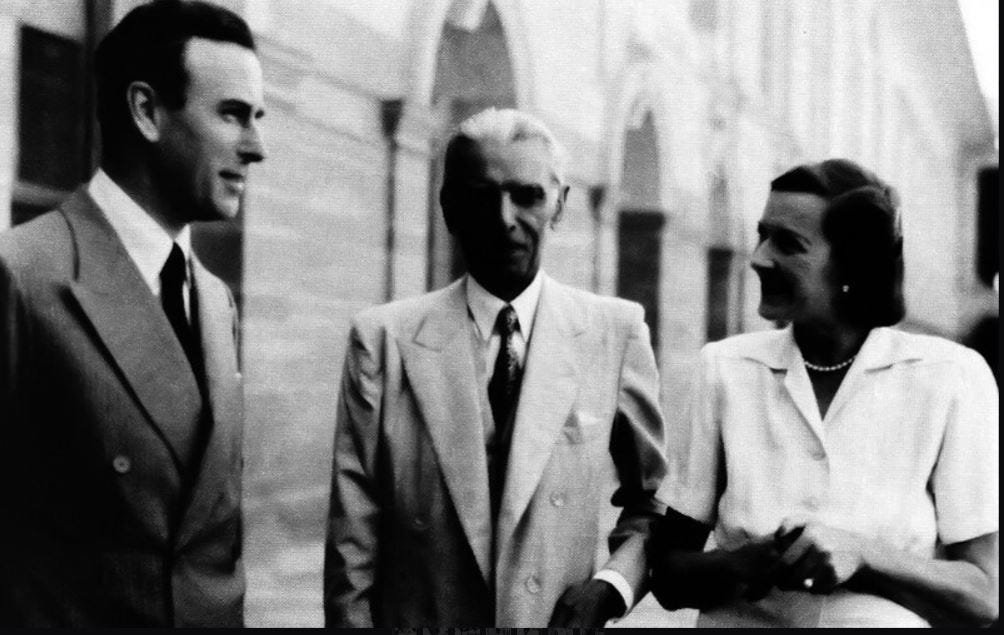
Now, why do I bring this up? In many ways, the above anecdote is a perfect metaphor for our times. Nations looking to chart their own course and assert their sovereignty find that the path they are trying to navigate is to become their own version of a ‘rose’ between the two thorns of the United States on one side and China on the other. On one side, you have the US champion itself as the leader of the ‘free world’ which is broadly taken as a broad-strokes coalition of democracies. The US has been the unipolar leader of the world order which it has shaped very much in its image following first, the end of WWII and secondly, following the end of the Cold War 1.0 with the collapse of the Soviet Union. On the other side, you have the emerging hegemon China which is following a very different economic model emphasizing state control over finance and credit and rejecting western style liberal democracy. It seems to be a matter of when, and not if, China’s economy (already larger in PPP) will overtake the US in nominal GDP terms. I do not intend to rehash the basic positionings of both these countries in terms of geopolitical clout; these have been extensively covered in previous articles. What I am more interested in are the so-called ‘pivot states’ who will need to balance between two superpowers to assert and follow their national interest. In this world of ever-growing complexity, it is often a fool’s errand to offer predictions or offer any sort of analysis as to how one perceives the roll of the geopolitical chessboard will turn out. But here is my take, distilled to five assertions.
1. While the unipolar world order is indeed dead (or in the advanced stages of its terminal decline) – the next stage is not necessarily multipolar (i.e., multiple, varied decentralized power centers across geographies).
2. The reality is that power abhors a vacuum and anarchy gives way to order. The notion of absolute sovereignty for each nation state and multiple, ever-changing power centers is akin to the utopian world of theoretical economics where there is perfect competition and constant change of dominant firms in the marketplace. The reality is that for the foreseeable future – there will be two poles: the Western-led and the Chinese-led.
3. There will be significant decoupling at the strategic level. For all the corporate interests who claim that there is ‘no alternative’ or that a complete realignment of supply chains etc. will be totally ‘unrealistic’ do not seem to realize that at the end of the day: politics > business. When there is sufficient political will, there will be a way. The laws of economic returns are not fixed unlike the laws of physics.
4. States will be increasingly forced to select sides. However, for a select few – lets call them ‘balancing powers’ or ‘pivot states’ – there will be the opportunity for outsize power and influence akin to what Britain was able to pull off at the height of its power in the 19th century by emerging as the key balancing power amongst the continental European nations.
5. However, while there will be these balancing / pivot powers – the nations that fall under this category will not be the same ones that held that title previously. So, countries like Japan (which emerged as the second largest economy during the Cold War 1.0 era) or France (which followed a somewhat independent foreign policy in the Gaullist era) will not be privileged to have that same role again. Rather, the three countries to keep an eye out for are the following: India, Canada, and Saudi Arabia.
We will examine why I selected the three nations of India, Canada, and Saudi Arabia as the emerging balancing powers later. In next week’s post we will examine the most dramatic example of a nation that had once secured a relatively independent balancing power status between the US and the Soviet Union but now finds its wings being severely clipped. That nation is France, and its current trajectory is to be a wilted rose between two thorns.